
Agents made data cheap. The value moved to the context.
The work of patient people with a spreadsheet, crawling through websites and PDFs and putting rows in a table, has become very cheap. With an agent, web search and a spreadsheet, you can compile a dataset that used to take weeks, or a lot of money, in an afternoon. Economists recently used agents to update a cross-country tax database for about the cost of a few hours of research-assistant work1.
To be clear, this doesn’t apply to proprietary data, or to data verified in some other way, geospatially or socially. That will keep its value for longer. Here, we mean public information: news, financial statements, earnings calls. It’s being processed, extracted, structured and stored faster and faster. There’s no need to wait for the next quarterly report or the next consulting engagement to get clarity. As Ben Thompson argued when Deep Research came out, the more searchable public information becomes, the more valuable non-public information gets2.
So where does the value go? It moves from collecting and structuring facts to putting them in context: connecting each new fact to the knowledge you already have.
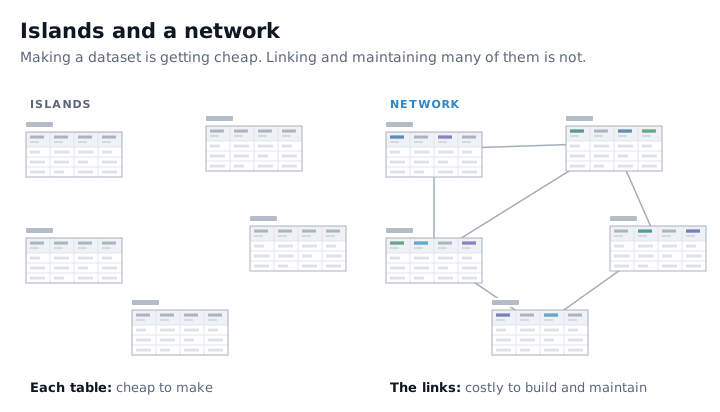
That part doesn’t get cheaper. Linking datasets, keeping them consistent with each other, and keeping them current is still hard work. Every new fact has to find its place in everything you already know.
The usual answer has been a central ontology that every data team must follow. But by the time everyone understands what an ontology is, half of them have changed roles. And by the time every business concept is mapped, the business has moved on. We believe an organisation’s knowledge has to grow organically: the important data emerges because it’s the data people link to and use most.
Technologies for linked knowledge, shared by agents and people, exist in principle: semantic layers, graph databases, versioned storage. But these building blocks aren’t integrated, and connecting a pile of MCP servers won’t fix that. If agents are going to collect, maintain, audit and analyse data in a way that creates value, the stack underneath them has to be fully integrated and allow fast iteration. Database researchers at Berkeley make a similar case: data systems built for people weren’t designed for agents that explore, edit and roll back at scale3.
That’s the stack we’re building with Mycorr. It starts from four problems:
- Datasets are isolated. In Mycorr, links between tables are a basic building block, across teams and across the organisation. A link doesn’t block anything from being written. It records which columns are meant to match, so you can audit where they don’t. That captures knowledge that would otherwise live only in people’s heads.
- Databases don’t know what their data means, beyond column names. Building on those links, Mycorr stores the meaning with the data: what each column holds, its unit, and how tables relate. Agents and people read the same definitions.
- Spreadsheets get used as databases, especially now that agents fill them. They are still just cells that look like a table, because you draw coloured lines around them. Mycorr feels like a spreadsheet but is a real database.
- Analytics and access control live in separate systems. In Mycorr, permissions are built into every part of the platform, and data stays owned by whoever owns it. That holds for analytics on billion-row tables and for joins across tables with different owners.
If these are problems you’re having, get in touch: maxs@mycorr.app
References
- Afonso, S., Galiani, S., Gálvez, R. H. and Sosa, R. A. (2026). "Deep Research on a Loop: Using AI Agents to Construct Economic Datasets." NBER Working Paper No. 35188, National Bureau of Economic Research, May 2026. https://www.nber.org/papers/w35188
- Thompson, B. (2025). "Deep Research and Knowledge Value." Stratechery, 10 February 2025. https://stratechery.com/2025/deep-research-and-knowledge-value/
- Parameswaran, A. G., Agarwal, S., Akillioglu, K., Shankar, S., Zeighami, S., Iyer, R., Zaharia, M., Cheung, A., Crooks, N., Gonzalez, J., Hellerstein, J. and Stoica, I. (2026). "Intelligence is Free, Now What? Data Systems for, of, and by Agents." Berkeley Artificial Intelligence Research (BAIR) Blog, 7 July 2026. https://bair.berkeley.edu/blog/2026/07/07/intelligence-is-free-now-what/