Your organization knows more
than it can remember.

Turn the knowledge locked inside your teams into structured, living data you can query — without a single line of code or an engineering ticket.

The Customers table already exists (sourced from Supabase); a Postgres database is dragged in and becomes a Subscriptions table, linked to Customers across two differently-named columns (id and account). Then, from any MCP client — Claude, ChatGPT, Codex or Gemini, each in its own interface — the user asks "Which customers churned last quarter?" and the assistant calls MyCorr and answers. Customers name String plan Categorical id Int64 Northwind Basic 1042 Brightline Pro 1043 Cedar Labs Basic 1044 Meridian Basic 1045 Source: Supabase Subscriptions account Int64 status Categorical renewed Timestamp 1042 churned Mar 2026 1043 active Jan 2026 1044 churned Feb 2026 1045 churned Mar 2026 Source: Postgres Subscriptions Ask wherever you are Which customers churned last quarter? MyCorr 3 customers churned last quarter — all on the Basic plan. Ask anything… Which customers churned last quarter?
Which customers churned last quarter?
3 customers churned last quarter — all on the Basic plan.

Data tools have solved the technical problem. They haven't solved the social one.

Knowledge lives in spreadsheets, in people's heads, in Slack threads — because the path from 'I know something useful' to 'it's in the database' runs through engineering. Mycorr removes that bottleneck.

Features

Built for how shared data really works — capture, collaboration, ownership, change, and trust.

Capture without code

Anyone creates and fills tables through a familiar spreadsheet canvas. Real database tables, created naturally — no SQL, no engineering ticket.

One live canvas, together

Teammates model and edit the same tables at once. Changes appear the instant they're made, so working with data feels like a shared room, not a chain of file handoffs.

No copies, only connections

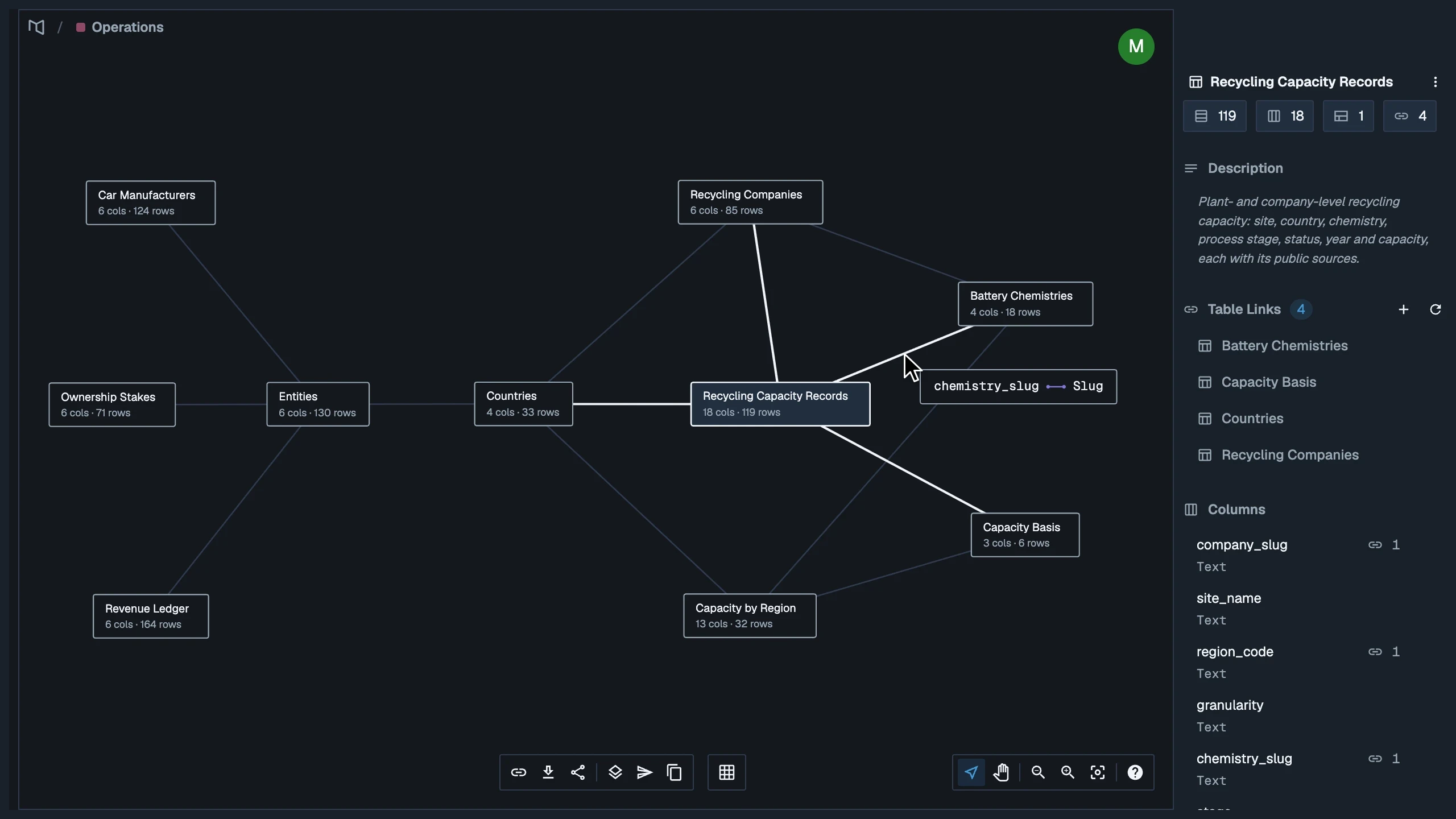
Import any table from any team as a live reference. Changes flow through the graph. One source of truth, used everywhere.

Safe schema evolution

Every schema change is versioned. Downstream teams stay pinned until they choose to fast-forward. Breaking changes are never forced.

Graceful ownership

Deleting a shared table opens a grace period. Others can copy it or the owner can transfer it. Data doesn't vanish because someone moved on.

Built for people and agents

Query from the Python client and MCP server. People, agents, and analytics tools all read the same live data — governed by your team's permissions, never a stale export.

The database your whole organization will actually use.

Not because they have to. Because it feels like a spreadsheet, behaves like infrastructure, and gets smarter every time someone on your team adds a row.